

Table of Contents
- Indoor Cannabis Grow Setup for Beginners: What You Actually Need
- Starting Seeds: Germination and Early Seedling Care
- Cannabis Grow Cycle Duration: Week by Week
- Indoor Cannabis Climate Control: Temperature, Humidity, and VPD
- Light Cycles, Nutrients, and Feeding Basics
- Troubleshooting: Reading Your Plants Before Problems Spread
- Harvest, Drying, and Curing for Better Terpenes
- Legal Compliance and Safety for Home Grows
- Frequently Asked Questions
Last Updated: September 17, 2026
Indoor Cannabis Grow Setup for Beginners: What You Actually Need
A beginner guide to indoor cannabis growing starts with one honest truth: the environment you create matters far more than the equipment list. Indoor cannabis growing is cultivating cannabis entirely under artificial light and controlled climate conditions inside a structure, giving you full command over light cycles, temperature, and humidity.
That control is the point: a tent or dedicated room lets you run your own light schedule, keep pests out, and protect genetics from weather.
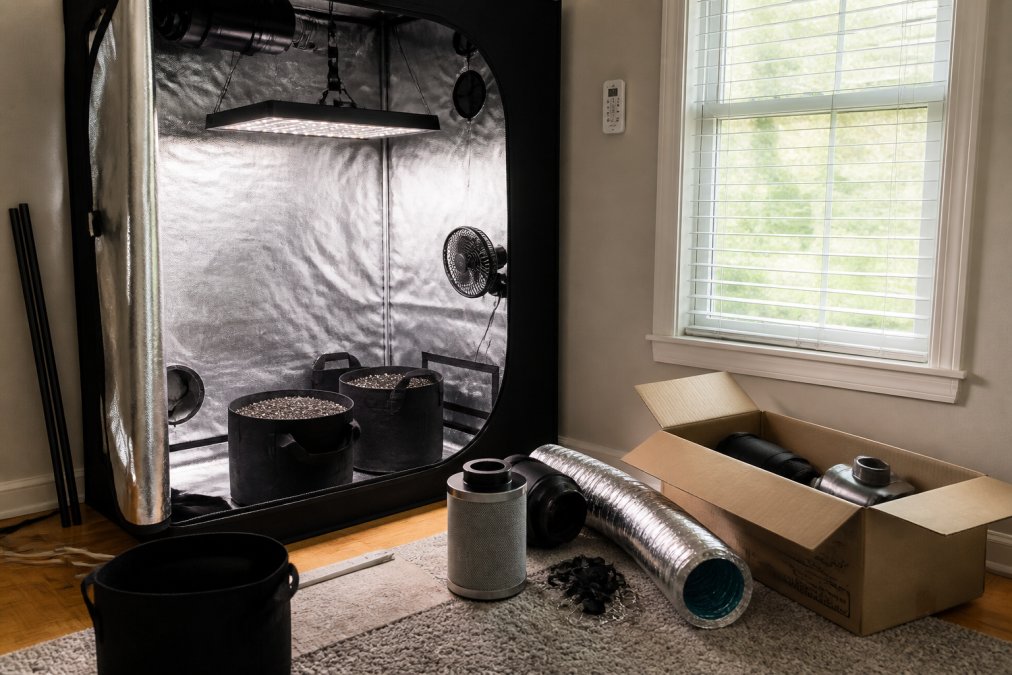
You need six things to start: a contained space, an LED grow light sized to that space, an exhaust fan with a carbon filter, a thermometer and hygrometer, a substrate such as a soil mix or coco coir, and a nutrient line built for cannabis. Everything else is refinement.
Budget Tier vs. Pro Tier Equipment
The budget tier works but demands more attention. A basic tent, mid-output LED, passive intake, and clip fan will carry a first grow if you monitor daily. Budget setups fall short on consistency: cheaper lights drift in intensity, and inexpensive fans fail mid-flower.
Pro tier buys automation and headroom: dimming drivers, controllers, and variable-speed inline fans let you dial conditions in rather than react. For a first run, put money into the light and exhaust fan first, those two set the ceiling on what the room can produce.
| Tier | Core Equipment | Best For | Trade-Off |
|---|---|---|---|
| Budget | Basic tent, fixed-output LED, passive intake, clip fan | First grow, single plant | Manual monitoring, less stable |
| Mid | Dimming LED, inline exhaust, carbon filter, hygrometer | 2-4 plants, repeat grows | Moderate upfront cost |
| Pro | Environmental controller, variable-speed fan, PAR meter | Perpetual harvests | Higher cost, more to learn |
Starting Seeds: Germination and Early Seedling Care
Germination wakes a dormant seed into active growth, taking roughly two to seven days under warm, dark, moist conditions. The paper towel method remains most reliable for beginners because you can see the taproot before committing the seed to substrate.
Fold a seed into a damp, not soaked, paper towel, place it in a sealed bag, and keep it somewhere near 75 to 80°F. Check daily. Once a white taproot emerges, plant it about a quarter inch deep, taproot down.
The seedling stage is where most beginners lose plants. Seedlings want high humidity, gentle light, and almost no nutrients. Feeding too early is a common mistake: a seedling carries enough stored energy for its first week or two, and nutrients before the first true leaves burn the root zone.
Keep your light at a safe distance and raise it as the plant stretches.
Cannabis Grow Cycle Duration: Week by Week
| Stage | Weeks | Light Cycle | Temp (lights-on) | RH | Feed Strength |
|---|---|---|---|---|---|
| Germination | 1 | Dark, warm | 75-80°F | High | None |
| Seedling | 1-2 | 18/6, low intensity | 70-80°F | 65-70% | None to 1/4 strength |
| Vegetative | 3-5+ | 18/6, rising intensity | 75-85°F | 60-70% | 1/2 to full veg strength |
| Flowering (stretch) | 6-8 | 12/12 | 75-82°F | 50-55% | Transition to bloom formula |
| Flowering (bulk) | 8-11 | 12/12 | 72-80°F | 40-50% | Full bloom strength |
| Ripening | 11-13 | 12/12 | 70-78°F | 40-45% | Taper or flush |
| Dry | 13-14 | Dark | 60-65°F | 55-60% | None |
| Cure | 14+ | Dark, sealed | 60-68°F | 58-62% in jar | None |
Rule of thumb: add two weeks to the breeder's listed flowering time as your realistic harvest window. Breeder numbers assume ideal conditions, and home tents rarely hit ideal.
Indoor Cannabis Climate Control: Temperature, Humidity, and VPD
Indoor cannabis climate control means managing temperature, relative humidity, and airflow together so transpiration stays optimal. Get this right and most other problems never appear.
Light Cycles, Nutrients, and Feeding Basics
Light cycles drive everything. Vegetative plants want 18 hours of light and 6 of dark; flowering plants want 12 and 12. That switch triggers flowering in photoperiod strains and must be uninterrupted, a single light leak during dark hours can stall or reverse flowering.
Troubleshooting: Reading Your Plants Before Problems Spread
Visual diagnosis beats guesswork. Leaves tell you what's wrong days before yield suffers, and reading them is the most useful skill a home grower develops.
Harvest, Drying, and Curing for Better Terpenes
Target conditions for drying:
- Temperature: 60-65°F. Warm rooms dry too fast and evaporate terpenes.
- Relative humidity: 55-60%. Below 50% and the buds dry unevenly; above 65% and you risk mold.
- Airflow: Gentle and indirect. A fan pointed directly at hanging buds will dry the outside while the inside stays wet.
- Light: Dark. Light degrades cannabinoids and terpenes on the surface of the flower.
- Duration: Roughly 7 to 14 days. The dry is done when a small stem snaps rather than bends. If it bends like a rubber band, it needs more time.
Safety matters as much during dry and cure as during the grow. Drying rooms combine hanging organic material, elevated humidity, and often an unattended heater or dehumidifier. Keep heat sources on a hard, non-flammable surface, never carpet or fabric. Plug dehumidifiers and heaters into a GFCI outlet, and never run them on an extension cord also powering lights or fans. In a closet or small room, a cheap smoke alarm belongs on the ceiling.
Legal Compliance and Safety for Home Grows
Legal compliance is not optional and varies by state. Cultivation limits, plant counts, and whether home growing is permitted at all are set at the state level, so check your state's rules before planting. Federal law still classifies cannabis differently from state programs, and hemp-derived genetics sit under separate rules.
Frequently Asked Questions
How hard is it to grow cannabis indoors?
It's manageable for a first-timer if you control three things: light, air, and water. A 2x2 or 4x4 grow tent, an LED grow light sized for that footprint, an exhaust fan with a carbon filter, and a simple pH and EC meter cover most of what you need. Most beginner failures come from overwatering, wrong pH, or heat spikes, not from complex technique.
How long does it take to grow an indoor cannabis plant?
Indoor cannabis growing typically runs 10 to 16 weeks from seed to harvest. Expect roughly 1 to 2 weeks for germination and seedling, 3 to 5 weeks in the vegetative stage, and 7 to 10 weeks in the flowering cycle, depending on the strain. Autoflowering varieties finish faster; photoperiod strains give you control over when flowering starts.
What is the best indoor grow setup for beginners?
Start with a 4x4 grow tent, a dimmable LED grow light rated for that footprint, a 4-inch inline exhaust fan with a carbon filter, a small oscillating fan for air movement, fabric pots with a quality soil mix, and a two-part nutrient line. Add a pH pen and an EC meter. This setup handles a full cannabis grow cycle duration without upgrades.
How much electricity does an indoor cannabis grow use?
A single 4x4 tent running a 300 to 480 watt LED light for 18 hours during veg and 12 hours during flower uses roughly 150 to 250 kilowatt-hours per month, depending on your light schedule and local rates. Exhaust fans, circulation fans, and a dehumidifier add more. Check your utility's rate per kWh to estimate your monthly cost before you start.
What are the legal considerations for growing cannabis at home?
Rules vary by state. Some states allow home cultivation of a set number of plants for adults 21 and over; others permit it only for registered medical patients; some prohibit it entirely. Check your state's cannabis authority before you buy seeds or equipment. Hemp genetics must stay under 0.3% Delta-9 THC to meet 2018 Farm Act standards.
How do I keep temperature and humidity stable in a small grow tent?
Run your exhaust fan on a thermostat controller so it kicks on when temps climb. Keep relative humidity between 60 and 70 percent during veg and drop it to 40 to 50 percent in flower to prevent bud rot. A small dehumidifier inside the room, plus air exchange every one to two minutes, keeps VPD in range and stops mold before it starts.
What should I look for in beginner-friendly cannabis seeds?
Look for stable genetics with documented lineage, photoperiod or autoflower options that match your schedule, and detailed effect profiles so you know what you're growing. Ask the breeder for third-party lab results showing Delta-9 THC below 0.3% if compliance matters to you, and confirm the seeds were produced without chemical pesticides.